Qatar Real Estate in a Changing Global Environment

A Calm, Long‑Term Perspective on Residential and Commercial Rentals
Periods of global and regional uncertainty naturally prompt people to pause, observe, and reassess. Recent developments in the wider region, alongside temporary impacts on travel and tourism, have led many landlords, tenants, and investors to ask a fair question: How will Qatar’s real estate market — especially rentals — respond in the months ahead?
At Malkiati, our intent is not to amplify headlines or speculate on extremes. Instead, we believe it is more valuable to step back and look at the market through a practical, on‑ground lens — separating short‑term disruptions from longer‑term fundamentals.
Understanding the Current Environment (Brief Context)
Like many markets globally, Qatar is currently experiencing a cautious phase marked by:
Reduced discretionary travel and tourism
Temporary adjustments in flight movements
A more careful approach to new commitments from businesses and individuals
These factors naturally influence sentiment. However, sentiment alone does not define market strength. Real estate performance — particularly rentals — depends on who drives demand, why they stay, and how flexible the market is during slower periods.
Residential Rental Market: Why Stability Still Exists
1. Rental Demand in Qatar Is Resident‑Driven, Not Tourism‑Driven
One of the defining strengths of Qatar’s residential rental market is that it is primarily supported by long‑term residents, not short‑term tourists.
Rental demand is largely anchored by:
Expatriate professionals on employment contracts
Families already living and working in Qatar
Employer‑provided or long‑term leased housing
Core sectors such as energy, government, healthcare, education, logistics, and infrastructure
Because residential demand is closely linked to employment and residency — not seasonal travel — it tends to be more stable during periods of external uncertainty.
2. Why Reduced Travel Does Not Automatically Translate to Rental Decline
While international movement and tourism activity may be temporarily subdued:
Most residents cannot relocate immediately due to job contracts and schooling commitments
Many potential buyers choose to delay property purchases, which often strengthens demand for rental housing
During uncertain periods, tenants typically priorities stability, preferring lease renewals over relocation
As a result, the residential rental market may slow in activity, but it does not abruptly weaken. It adjusts gradually and pragmatically.
3. Where Pressure May Be Felt in Residential Rentals
It is equally important to remain realistic.
Some pressures may emerge in:
Luxury or premium rental segments
Short‑term or serviced apartments
Properties positioned primarily for corporate travel or transient stays
In these cases, landlords may notice:
Slightly longer vacancy periods
More price sensitivity and negotiation
Increased flexibility in lease terms
This should be seen as a correction and recalibration, not a structural breakdown of demand.
Commercial Rental Market: A More Cautious Phase
Commercial real estate typically responds faster to uncertainty than residential housing.
In the current environment, we may see:
Businesses delaying expansion decisions rather than existing markets
Companies optimizing space usage instead of committing to larger offices
Increased interest in flexible, cost‑efficient, or smaller office configurations
At the same time:
Core business sectors in Qatar remain operational
Essential services, logistics, professional firms, and government‑linked entities continue to function
Established and prime commercial locations generally retain relevance
The commercial rental market is therefore more likely to realign and rebalance than retreat.
Rental Stability Does Not Mean “No Impact”
When we speak of rental stability, it is important to be precise.
Stability does not mean:
No adjustments
No negotiation
No shifts in tenant behavior
Rather, it means:
No widespread panic exits
No sharp or disruptive rental crashes
No mass vacancies across the market
In practical terms, the rental market bends and adapts. It does not abruptly break.
Looking Ahead: The Medium‑ to Long‑Term View
Looking beyond short‑term uncertainty, Qatar’s real estate market continues to be underpinned by:
Long‑term economic planning and fiscal discipline
Energy‑led financial strength
Population continuity and employment‑linked residency
Ongoing infrastructure and urban development
A regulated and transparent property framework
Historically, markets that move through cautious phases often emerge more disciplined, demand‑driven, and sustainable.
A Final Thought from Malkiati
As a new platform in Qatar, Malkiati’s role is not to predict extremes, but to support informed, grounded decision‑making.
The current phase of the market calls for:
Realistic expectations
Long‑term thinking
Focus on rental fundamentals rather than speculation
For tenants, landlords, agents, and investors alike, clarity matters more than headlines.
Conclusion
At Malkiati, we believe transparency, balanced perspectives, and long‑term thinking are essential to building lasting trust in Qatar’s property market.
- by Team @ Malkiati
Related Articles
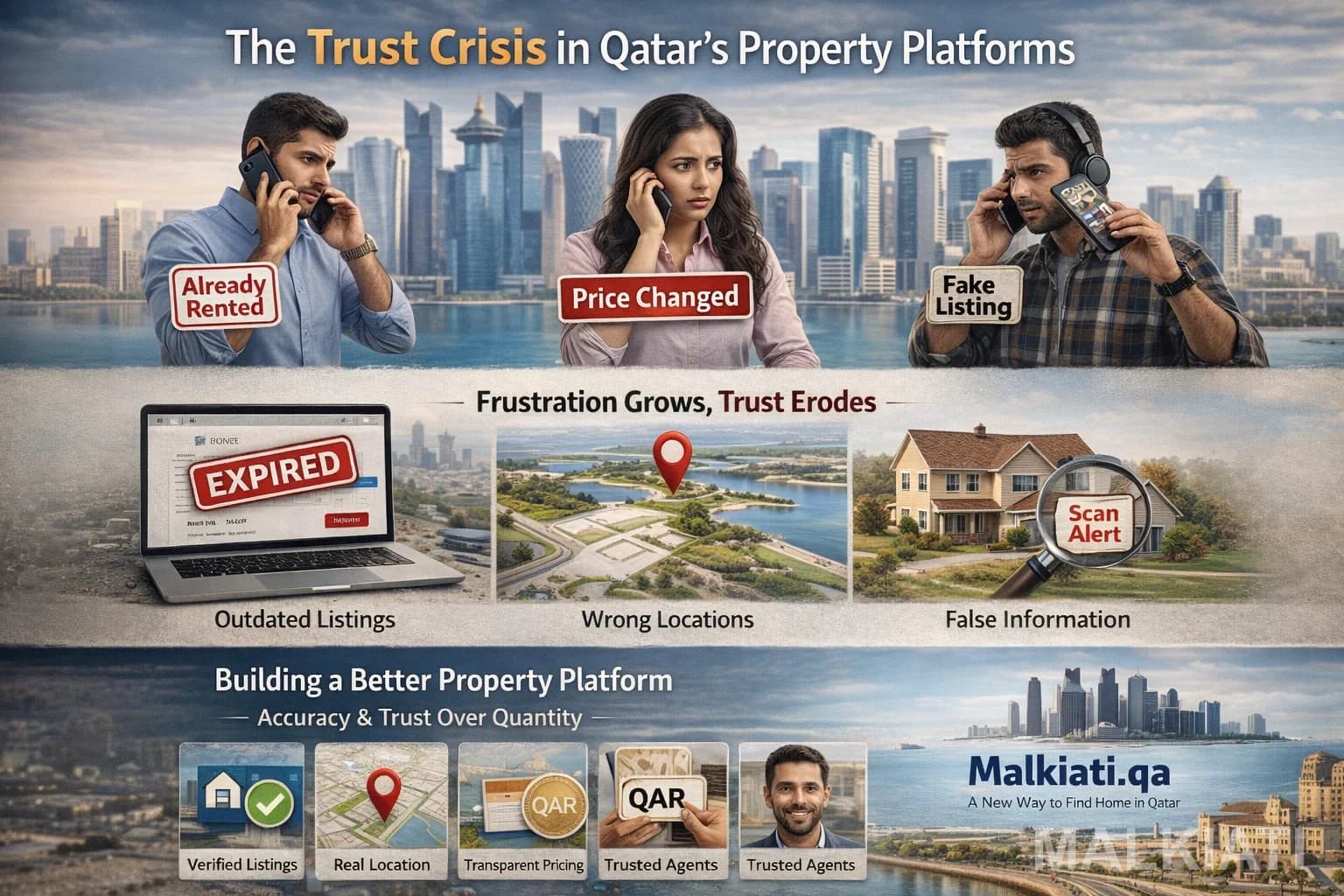 Market Insights & Trends
Why Trust Is the Real Missing Layer in Qatar’s Property Platforms
Searching for a home should be an exciting step.For many people in Qatar, it has become a ...
 Market Insights & Trends
Properties for Sale in Lusail Qatar: What to Know
Lusail is where many buyers in Qatar start when they want newer inventory, planned communi...
 Market Insights & Trends
Properties for Sale in Pearl Qatar: What to Know
The difference between a smart purchase and an expensive mismatch in The Pearl often comes...